But I won’t spoil it for you just yet, because the history of the Bando de la Huerta has quite a story to tell.
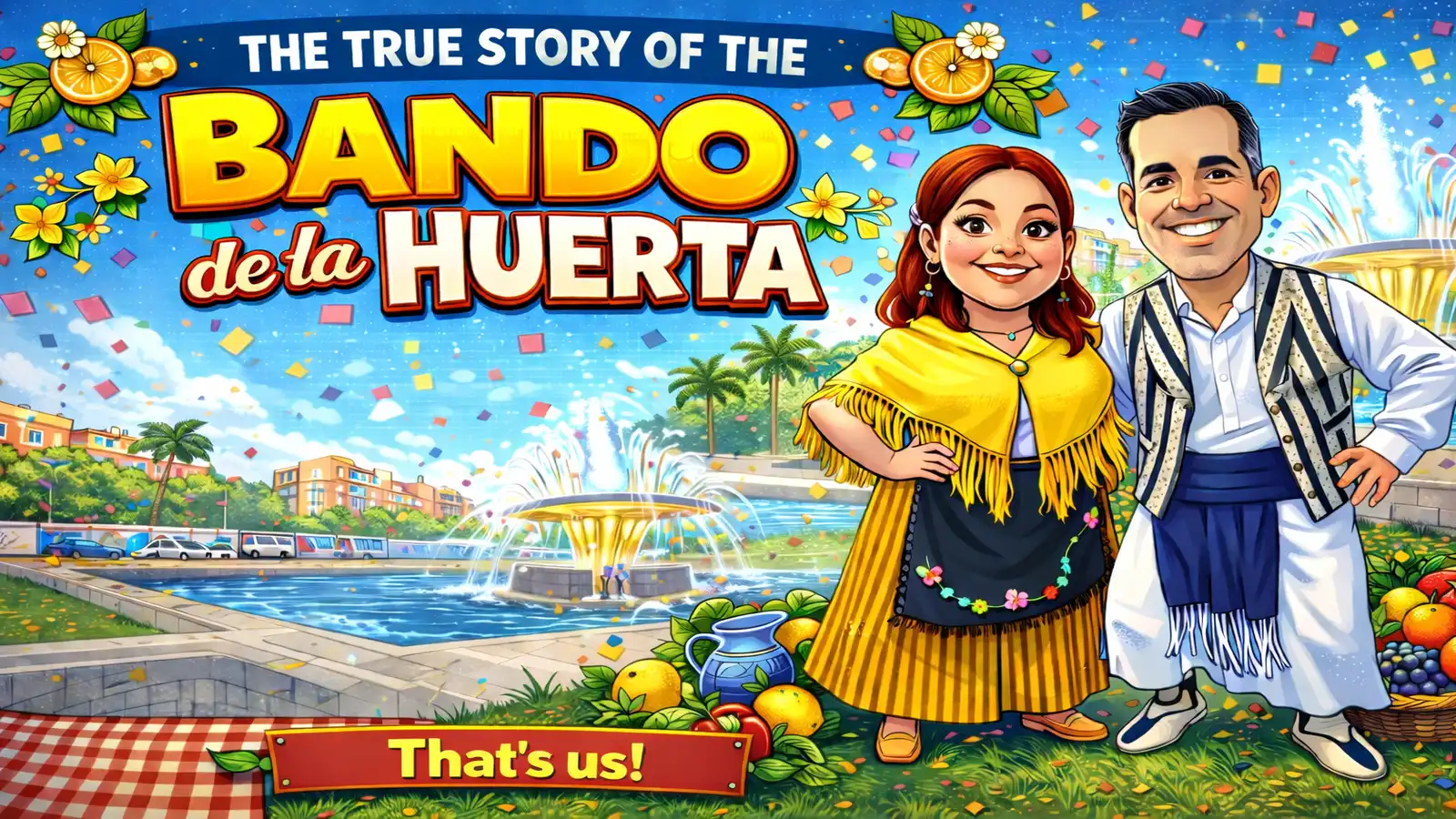
The Origin of the Bando de la Huerta: An Old-Fashioned Prank
➡️ The history of the Bando de la Huerta begins in a way that might surprise many.
To understand the true origin of the Bando de la Huerta, we have to go way back.
Picture this: Murcia, the year 1851. A group of wealthy young men, many of them students who had returned from Madrid, used to hang out in the back room of an old pharmacy in the San Antolín neighborhood.
They were bored, as often happens, and they came up with an idea that they thought was hilarious: dressing up as huertanos (farmers from the orchard). But not to honor them — to make fun of them.
To imitate the way they walked, the way they spoke that distinctive “panocho” dialect which they saw as backwards, and to exaggerate their customs.
That was the real origin of the Bando de la Huerta: a masquerade with no other purpose than to mock the poor.
The first parade started from the San Agustín bullring. Two “majos” on horseback led the way, one horse decorated with palm branches and vegetables, followed by a bunch of kids dressed in traditional costumes, taken to the point of caricature.
They called it Bando because they went through the streets reading proclamations in verse, written in the Murcian dialect, telling stories about the orchard in a satirical way. Basically, what you’d call an old-fashioned mockery.
This curious history of the Bando de la Huerta started as a joke, but over time it would transform into something much bigger.
It All Started in 1851, Believe It or Not
Because yes, hard as it may be to believe, the Bando de la Huerta 1851 is the year experts point to as the birth of this festival. And boy, has it been a long time since then.
What many people don’t know is that the Bando has disappeared and reappeared more times than you can imagine. Those in the know distinguish five distinct stages, with years and years when it wasn’t celebrated at all.
The first period was from ’51 to ’65, but it gradually fizzled out until it disappeared completely. Then there was an attempt to revive it in 1876, but just three years later came the Santa Teresa flood of 1879, which devastated the orchard and killed hundreds of people.
Can you imagine? After such a disaster, who would be in the mood to party? The Bando was forgotten for over twenty years.
At the end of the 19th century, there was another attempt, but at least one good thing came out of it: the Battle of the Flowers, which we still have today.
The golden age arrived at the beginning of the 1900s, between 1900 and 1936. The parade had become so famous that people came from Cieza, Lorca, and Cartagena to see it.
It was then that the Bando and the Entierro de la Sardina (Burial of the Sardine) definitively separated, because before they were held together. The festival became so popular that other towns started copying it.
Then came the Spanish Civil War, and of course, between ’37 and ’38 there was nothing to celebrate. But as soon as the war ended, in 1939, the Bando rose again, although they moved it to September and held it in the afternoon.
It wasn’t until 1943 that they put it on Easter Monday, which later changed to Easter Tuesday, which is when we celebrate it today.
As you can see, the history of the Bando de la Huerta is full of ups and downs, but it always came back to life.
📺 To Understand It Better: A Documentary About the Origins
Before we continue, I want you to watch this short documentary. Because reading about it is one thing, but seeing with your own eyes where we come from is something else entirely.
These images clearly and engagingly explain that origin of the Bando de la Huerta that I’ve had such a hard time telling you about. You’ll see how that joke from 1851 took shape over the years, how it survived floods and wars, and how it ended up becoming what it is today.
Because history is great, but when you see it in motion, it gets into your eyes and stays with you. Hit play, and we’ll continue — I still have the best part left.
The Moment Everything Changed
➡️ This chapter of the history of the Bando de la Huerta is, for me, the most exciting one.
The key year is 1967. That’s when the festival took a turn that changed its history.
A man named Francisco Galera del Cerro had the idea of creating local neighborhood councils, which over time became the huertana associations (peñas). And between late ’74 and early ’75, the Federation of Huertana Associations was born, which organizes everything today.
And what happened? People, instead of continuing to see the Bando as a joke, began to take ownership of it.
The huertanos themselves — the real ones, the ones who had been the target of the mockery — decided to turn the tables. It was no longer about laughing at the orchard, but honoring it.
And that’s how we know it now: a day to feel proud of our roots, of our grandparents who worked their backs off in the fields, of our way of being.
➡️ That ugly origin of the Bando de la Huerta was left behind forever. Today no one remembers that ugly origin of the Bando de la Huerta. The Bando is ours, period.
🎞️ This Is How the Bando Was Celebrated in 1973: A Black and White Treasure
Speaking of when the Bando was already ours, check out this video. It’s from 1973. My grandfather was my age back then, and he was probably out there wearing his traditional baggy pants.
Look at the floats, the queens of the orchard with their orange blossom crowns, the way they danced. No color, no cell phones, no posing. Just a desire to honor the land.
This is what I experienced as a child watching my father, and what he experienced watching his. Keep this video as what it is: a document from when the festival was already beating with the heart of the orchard, not with the mockery of a few.
The queens you see here are probably grandmothers by now, but their smile is the same one you’ll see this Tuesday on the street.
This Is Not Just a Parade
Because look, the Bando is not just about watching the floats and groups pass by. It’s so much more.
It’s choosing the Queen of the Orchard and placing the Orange Blossom Crown on her. It’s the Children’s Bando, which I think is one of the most beautiful things.
It’s the Huertana Mass in front of the Virgin of Fuensanta, which gives you goosebumps even if you’re not very religious.
➡️ If you’re interested in learning more about our religious traditions, don’t miss this complete guide to Easter Week in Murcia, where I tell you about the processions, the Salzillo sculptures, and the most authentic anecdotes.
And then there are the barracas (traditional booths). The associations, with names that are poems in themselves — “El Zaragüel,” “La Esparteña,” “El Tablacho” — set up in squares and gardens and spend the day cooking.
Michirones (bean stew), zarangollo (zucchini scramble), blood sausages, and paparajotes (lemon leaf fritters), which are a must. People go from one booth to another, have a drink, run into friends, and even though you can’t move, everyone is in a good mood.
In 1972, the Week of the Orchard was even born in Los Alcázares, which is a pilgrimage of huertanos heading down to the beach, just like they used to do in the old days.
🍻 What Young People Think: The Bando as Fun and Partying
Now it’s time to be honest. Not everything about the Bando is tradition and sentiment. There’s also the street side, the part where young people go out to enjoy themselves their own way.
This video is from 2014 and shows without filters what many think: drinking in the streets, laughter, hooking up, and having a good time. And hey, I’m not criticizing it.
Every age has its own way of experiencing the festival. When I was twenty, I also went out with my friends to drink and laugh without thinking much about the orchard grandparents.
Over the years, you change. But the Bando is for everyone: for those who get emotional at the Huertana Mass and for those who just want to have a few drinks with their buddies.
Watch it, laugh if you want, but don’t judge. Because in the end, we’re all on the same street.
And Now Let Me Tell You Why This Is About the Heart, Not About Posturing
Look, I live this in a very personal way. And after telling you this whole history of the Bando de la Huerta, I’m going to get serious for a moment — because that’s what being from here is all about.
I’m a Murcian through and through. I’m 43 years old and I’ve seen many Bandos come and go.
Since I was a kid, I remember watching my father put on his zaragüelles and thinking that when I grew up, I wanted to do the same. And here I am.
Every year, when Easter Tuesday arrives, I dress up as a huertano and feel something hard to explain. It’s not putting on a costume. It’s dressing up as who you are.
It’s like reconciling with your grandfather, with the land that saw you born, with the sun that’s been beating down on you your whole life. It sounds corny, but it’s true.
But the best part is that I don’t do it alone.
My wife is Colombian. She came to Spain, came to Murcia, and I don’t really know what happened in her head, but the land got into her feet.
She fell in love with all of this. The processions, the festivals, the food, the heat that lasts even until December.
And when she puts on the refajo (skirt), the apron, and ties the scarf around her head, I tell you something: no one can tell her apart from a lifelong huertana.
She is, as I like to say, a Murcian adopted by Spain. And she carries it with a pride that sometimes I envy.
This year, however, things haven’t been easy. My wife recently had a spinal arthrodesis.
It’s a major surgery, the kind that leaves you knocked out for weeks and weeks. And her recovery is being slower than she’d like. She’s a bit discouraged, and I’ll be honest with you — that breaks my heart.
Because she knows that Easter Tuesday is coming. She knows that this year she won’t be able to spend hours and hours standing at the barraca.
She won’t be able to dance to the sound of the tambourine, or walk through downtown Murcia with the group. And that hurts her, not just in her back, but in her soul.
But there’s something she has that neither the pain nor the surgery nor anything else can take away: the desire.
And I know her. I know that even if she has to go sitting in a chair, with a pillow on her back and her body begging her to stop, she’s going to be there.
With her scarf tied around her head. With her refajo, even if it’s a little tight. With that smile that sometimes twists a bit because it hurts, but is sincere.
Because the Bando, in the end, isn’t for those who can endure the most. The Bando is for those who carry it inside.
And my wife, even though she was born thousands of miles away, carries it inside. More than many who were born right next to the cathedral.
🌸 The Bando Today: The Queen, the Floats, and the Pride That’s Non-Negotiable
And to finish this review in images, I want you to see last year’s Bando. Look closely at the queens of the orchard, how they wave from the floats, how people applaud and cheer.
Because this has nothing to do with that joke from 1851. This is something else. This is the festival we’ve built together: those from before, those from now, those born here, and those who arrived later.
Look at the costumes, the colors, the flowers, the smiles. And while you watch, think of my wife, who this year will be slower but with the same crown in her heart.
Because dressing up as a huertano isn’t about strength. It’s about heart.
So Now You Know the True History of the Bando de la Huerta
The Bando de la Huerta started as a bad joke, a mockery by some rich kids of the farmworkers. That was the origin of the Bando de la Huerta, strange as it may seem.
And look at what has happened over time, from that distant Bando de la Huerta 1851 until today. Now it’s our festival.
Everyone’s. For those born here and for those who arrived later and decided to stay.
➡️ If you want to keep reading about our traditions and way of speaking, I recommend this article about 10 Murcian expressions they won’t understand in Cali, Colombia. Because “panocho” is ours, and we have to show it off.
➡️ And speaking of celebrating: the Bando de la Huerta turns 175 years old in 2026. To find out about all the events and news of this special edition, don’t miss the complete coverage at Murcia Actualidad, where they explain how the city becomes the grand stage of the Spring Festivals.
This year I’m going to put on my zaragüelles, my montera hat, and my esparteña sandals. I’m going out into the street. And by my side, she’ll be there.
Slower than other years, but with her head held high. With the pride of someone who chose this land and this land chose her.
Because dressing up as a huertano isn’t about strength. It’s about heart. And my wife’s heart, even though she’s recovering, beats to the rhythm of the orchard.
And that, I assure you, no surgery can take away.
Frequently Asked Questions About Words in the Article
So you don’t have any doubts, here I explain the words and expressions that have appeared in this history of the Bando de la Huerta. In case you’re not from Murcia, you’re younger, or you just got curious.
What is an arthrodesis?
It’s a surgical procedure where two or more vertebrae in the spine are fused together to stop them from moving and thus relieve pain. It’s major surgery, the kind that leaves you knocked out for weeks. Hence why my wife’s recovery is so long and complicated.
What are the “barracas” of the Bando?
No, they have nothing to do with Valencian barracas. In the Bando de la Huerta, barracas are booths or stalls that the associations set up in squares and gardens. There they cook, eat, drink, and party. Basically, the operations center for each group.
Why is this festival called “Bando”?
The name comes from the proclamations in verse that were read in the streets back in the day. They were written in the Murcian dialect and told stories about the orchard in a satirical way. At first it was a mockery, but today those proclamations are still read with pride.
What is the Orange Blossom Crown?
It’s the award given to the Queen of the Orchard. It’s made with orange blossoms, which come from orange trees. It’s a symbol that’s very much ours because there have been orange trees in the orchard forever. It smells like pure Murcia.
What is a huertana group (cuadrilla)?
It’s simply a group of friends or family who dress up as huertanos and go together during the Bando. Some appear in the official parade, others just go from booth to booth. But they’re all a group.
What is the relationship between the Bando and the Entierro de la Sardina (Burial of the Sardine)?
They used to be held together, but over time they separated and each festival went its own way. The Bando de la Huerta is celebrated on Easter Tuesday. The Entierro de la Sardina, on the other hand, is on the Saturday of the Spring Festivals, which is the Saturday after Easter Week. So, first comes the Bando and then, a few days later, the Entierro. Not the other way around. And both are major festivals, each in its own moment.
What are esparteñas?
They are traditional shoes made of esparto grass, a very common plant in the Murcian countryside. The huertanos wore them to work the land because they’re cool and durable. Today we still wear them in the Bando as part of the authentic costume.
What is the Federation of Huertana Associations?
It’s the organization that coordinates and manages the Bando de la Huerta today. It was founded between 1974 and 1975 and brings together all the associations from different districts and neighborhoods of Murcia. Without them, this wouldn’t work.
What is a huertano or huertana?
Originally, a person who lives or works in the orchard, that irrigated belt that surrounds Murcia. But during the Bando, anyone who dresses in traditional costume is considered a “huertano” that day, even if they live downtown. And my wife, even though she’s Colombian, is more of one than many.
What does “more huertano than the song of a malagueña” mean?
It’s a typical Murcian exaggeration. The malagueña is a style of flamenco very linked to Murcia and its Easter Week, despite its name. The singing of the malagueña is deep and heartfelt. Saying something is more huertano than that means it’s extremely huertano.
What is a mandil?
It’s the piece of fabric tied at the waist that covers part of the refajo skirt. It’s one of the elements of the female huertana costume. They are often embroidered with flowers and very bright colors. Each woman has her own and treasures it.
What are michirones?
A typical Murcian stew made with dried fava beans, chorizo, bacon, and spices. It’s served hot and is one of the star dishes in the Bando’s barracas. If you don’t try michirones on Easter Tuesday, you haven’t really been to the Bando.
What is the montera huertana?
It’s the traditional hat that men wear in the huertano costume. It has a characteristic shape, with a rounded crown and often tassels or side decorations. Don’t confuse it with the bullfighter’s montera, which is different. Ours is more practical.
What does “murcianica” mean?
It’s a sweet, colloquial way of saying Murcian woman. It’s used especially to refer to a woman from Murcia or, as in this article, someone from outside who has integrated to the point of being considered one of them. My wife is an adopted murcianica, and she wears it with pride.
What is “panocho”?
It’s the traditional speech or dialect of the Murcian orchard. It has its own words, turns of phrase, and pronunciations. In the past, it was used to make fun of farmworkers; today it’s a mark of identity that is defended and taught. Words like “achiliparse” (to get sunburned) or “esgarrarse” (to choke) are pure panocho.
What are paparajotes?
The typical dessert of Murcia. They are lemon tree leaves dipped in a batter of flour, egg, and milk, fried, and sprinkled with sugar and cinnamon. You eat the batter, not the leaf. If you don’t like paparajotes, something’s wrong with you.
What is a huertana association (peña)?
It’s an association or group of people who organize themselves to participate in the Bando de la Huerta. Each association has its own barraca, its own group, and its own traditions. There are associations in every neighborhood and district. And they are the soul of the festival.
What was a “rebotica”?
It was the back room of an old pharmacy where the pharmacists prepared their ointments and medicines. In the 19th century, they were also used as meeting places for tertulias (literary or social gatherings). And it was in one of those back rooms in the San Antolín neighborhood that the idea for the first Bando was born in 1851.
What is a refajo?
It’s the traditional skirt of the female huertana costume. It’s usually bright colors (red, blue, green) and richly embroidered with flowers and folk motifs. Petticoats are worn underneath to give it volume. When my wife puts on the refajo, no one can stop her.
What was the Santa Teresa flood?
The terrible flood that Murcia suffered on October 15, 1879, Saint Teresa’s day. The Segura River overflowed and devastated the orchard, causing thousands of deaths and immense destruction. It was one of the greatest natural disasters in the history of the region. And the Bando disappeared for twenty years because of it.
What is the Week of the Orchard?
It’s a celebration that was born in Los Alcázares in 1972 as a tribute to the huertanos who used to go on a pilgrimage to the beaches of the Mar Menor. It complements the Bando and is celebrated around the same dates. Less well-known, but just as authentic.
What is zarangollo?
Typical Murcian dish made with zucchini, onion, and scrambled egg. Sometimes potato or garlic is also added. It’s simple, cheap, and delicious. The huertanos ate it because it was what they had on hand in the orchard. And we still eat it because it’s to die for.
What are zaragüelles?
They are the traditional pants of the male huertano costume. They are white, wide, and fitted at the waist and knee, giving a puffy appearance. They are the most characteristic and recognizable garment of the huertano. In the old days, farmworkers wore them for freedom of movement. Today I wear them every Easter Tuesday, and I’m happy.
With this, you have no excuse to miss a single word. Now go enjoy the Bando with all the vocabulary learned. And if you still have any questions, you know, ask at any barraca. There’s always a Murcian there ready to explain it to you.
📢 Now It’s Your Turn: What Does the Bando Mean to You?
I’ve told you the history of the Bando de la Huerta, how that curious origin of the Bando de la Huerta back in 1851 came to be, and I’ve shared how I live it with my 43 years and with my wife, that adopted Murcian who this year is slower but with the same desire as always.
But now it’s my turn to listen to you.
Leave me a comment below and tell me:
- Are you a Murcian through and through, or did you arrive later and fall in love with the festival?
- Do you dress up as a huertano or huertana every Easter Tuesday?
- What’s your association? Your favorite barraca? Your must-have dish? (I’ll die defending paparajotes, just so you know.)
- Did you know about this ugly origin of the Bando? Did it surprise you?
- And if you have a personal story like mine — someone who can’t enjoy it 100{107f6b3c5a59703da457b4209c83990a37b7823a5dfe35be921e22056d25a32d} this year but still shows up — here’s your place to tell it.
Go ahead, this isn’t just my article. It belongs to everyone who carries the orchard in their heart.
And remember what I always say: dressing up as a huertano isn’t about strength. It’s about heart. So even if you’re slower this year, or if something hurts, or if you can only peek out the window for a moment… you’re still part of this.
I’ll read you in the comments. And if you liked the article, share it — together we keep the flame of our most authentic festival alive.