If you’re looking for a one-of-a-kind experience where Baroque art, deep faith, and local farming traditions merge into an unforgettable spectacle, Murcia Holy Week processions are your must-visit destination. Declared an International Tourist Interest event, this celebration isn’t just about the incredible sculptures by masters like Francisco Salzillo—it has a unique style you won’t find anywhere else in Spain: the traditional Murcian way.
In this complete guide to Murcia’s Easter processions, we invite you to discover the best Holy Week processions you can experience in the capital of the Segura River. From the roar of the “Burlas” (mockery trumpets) to the scent of orange blossoms in the plazas, we’ll explore a detailed inventory of all 93 processional floats, the schedules of each brotherhood, and those quirky anecdotes that make Murcian Nazarenes the most generous in the world. Get ready for a sensory journey through the heart of the Region of Murcia that will captivate you from the first ray of sun on Friday of Sorrows.
Why Murcia’s Holy Week Is Unlike Any Other in Spain
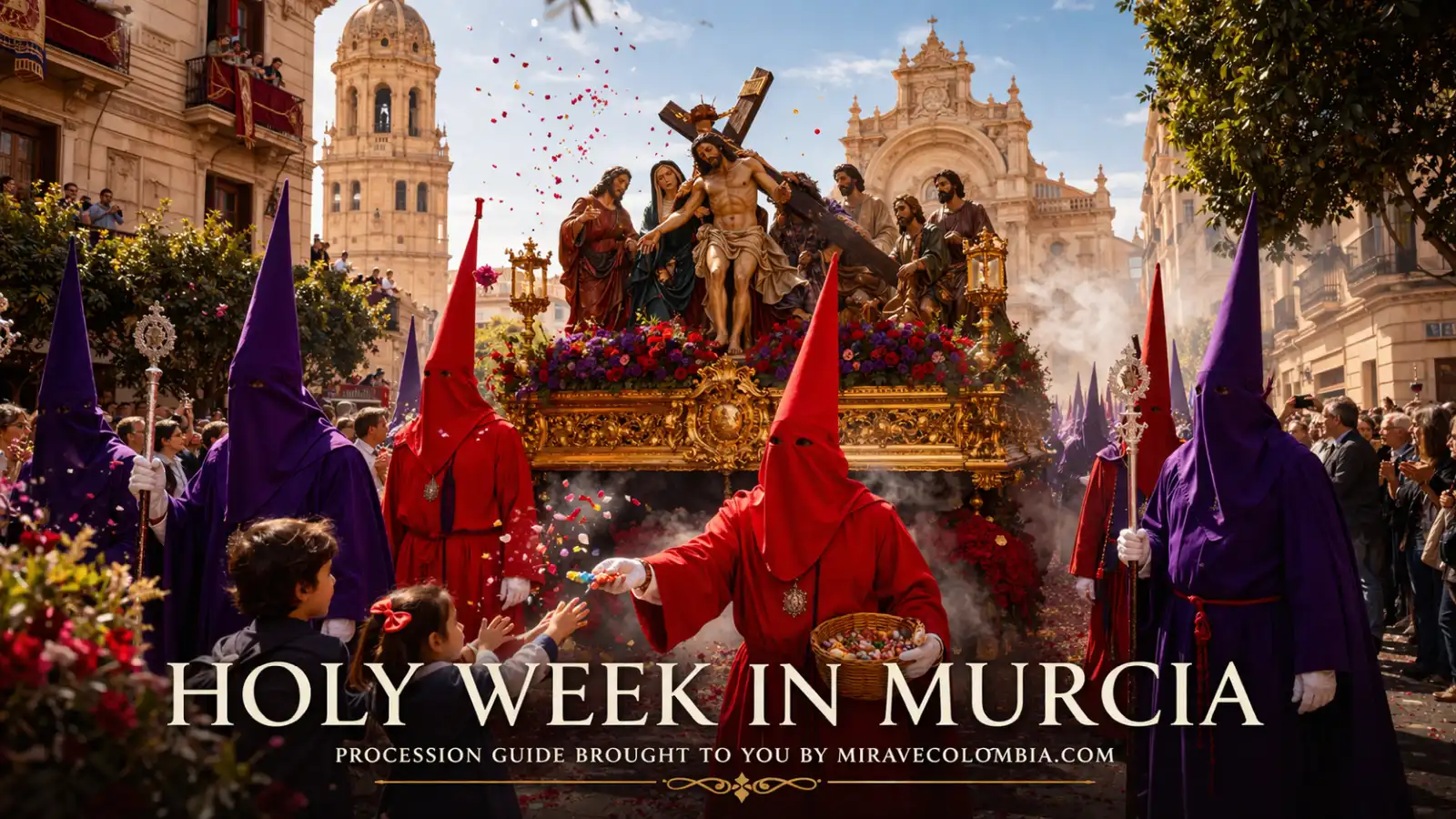
Murcia Holy Week processions turn the city into a living museum. What makes these Easter parades unique is the “Traditional Murcian Style”: Nazarenes in short tunics, patterned knit stockings, esparto grass sandals, and the famous “buche” (a pouch) stuffed with candy and snacks. Here, the estante (the float carrier) holds the throne on a single shoulder, marking a rhythmic, courageous step that makes the statues seem to walk. Without a doubt, experiencing Murcia Holy Week is something every tradition lover should enjoy at least once in their life.
Below, we walk through each day, each brotherhood, a technical description of every float, and the stories that make this city’s heart beat. If it’s your first time attending Murcia Holy Week processions, we recommend starting with the Los Salzillos procession on Good Friday morning—the most iconic of all.
🗓️ Complete Guide to Brotherhoods and Floats (Day by Day)
So you don’t miss a thing of Murcia Holy Week processions, here’s the day-by-day breakdown of all the Easter parades that fill the city’s streets.
🔵 Friday of Sorrows: Brotherhood of Amparo
- Headquarters: Church of San Nicolás de Bari. Color: Cobalt Blue. Time: 7:00 PM – 12:00 AM.
- Holy Flagellation (José Hernández Navarro, 1994): Christ tied to a low column. Standout feature: the anatomical realism of lacerated skin and tensed muscles.
- Jesus before Pilate (Antonio Castaño, 1945 / Sánchez Lozano, 1982): The “Ecce Homo” moment, with Pilate presenting Jesus to the crowd in hesitation.
- Jesus of Great Power (Nicolás de Bussy, 1693): A Baroque carving full of pathos; shows Christ carrying the cross with an expression of superhuman suffering.
- Encounter on the Via Dolorosa (Hernández Navarro, 1996): A three-figure group (Jesus, Virgin, and St. John) meeting in a dramatic exchange of glances.
- St. John (Gregorio Molera, 1942): A youthful image of the evangelist, pointing the way to Calvary.
- Virgin of Sorrows (Francisco Salzillo, 1741): Idealized beauty, clasped hands, and a pleading gaze to heaven that moves you to the core.
- Most Holy Christ of Amparo (Attributed to Francisco Salzillo, 1739): The titular float. A deceased crucifix with perfect proportions and a serenity that contrasts with the day’s grief.
🟤 Saturday of Passion: Faith and Charity
Brotherhood of Faith (Brown): (6:00 PM – 10:15 PM)
- Christ of Faith (Antonio Dorrego, 1959): Crucifix in dark wood, simple lines, deep mysticism. It parades in absolute silence with Franciscan sobriety.
Brotherhood of Charity (Corinth): (8:00 PM – 12:30 AM)
- Prayer in the Garden (Arturo Serra, 1996): Jesus comforted by an angel on the Mount of Olives.
- The Flagellation (Hernández Navarro, 2007): Jesus suffering the lashes of two guards with great dynamism.
- The Crowning with Thorns (Hernández Navarro, 1997): Jesus seated, being mocked by a Roman soldier.
- Our Father Jesus of the Way (Hernández Navarro, 2010): Christ carrying the cross in a marching posture.
- Holy Woman Veronica (Hernández Navarro, 2003): Holding the cloth with the imprint of the Holy Face.
- St. John (Hernández Navarro, 2002): A figure of the apostle with dramatic movement in his robes.
- Maria Dolorosa (Hernández Navarro, 1993): A contemporary, powerful expression of maternal grief.
- Christ of Charity (Rafael Corona, 1994): The titular float. An imposing deceased crucifix with pale features and immense size.
- Lord of the Rescue (Salzillo School, 18th Century): A dressed image with deep popular devotion.
🟢 Palm Sunday: Hope
- Headquarters: Church of San Pedro. Color: Green. Time: 6:00 PM – 10:30 PM.
- Let the Children Come to Me (Hernández Navarro, 2009): Jesus blessing children dressed as Murcian farmers; the sweetest float in Murcia.
- Entry of Jesus into Jerusalem (José Planes, 1947): The famous “Little Donkey” float with triumphant Jesus greeting the people.
- St. John (Antonio Labaña, 1984): A youthful image of the apostle carrying a white palm.
- Virgin of Hope (Francisco Salzillo, 1755): A dressed Sorrowful Virgin with fine features and supreme elegance.
💗 Holy Monday: Forgiveness
- Headquarters: Church of San Antolín. Color: Magenta. Time: 7:00 PM – 1:00 AM.
- Angels of the Passion (Hernández Navarro, 1996): Two angels carrying symbols of martyrdom.
- The Samaritan Woman (Roque López, 1781): The scene at Jacob’s well, crowned with a real palm tree on the float.
- The Washing of the Feet (Juan Dorado, 1904): 13 life-sized figures. The heaviest and most monumental float in the city.
- Prayer in the Garden (Sánchez Lozano, 1973): Inspired by Salzillo’s famous work.
- The Arrest (Hernández Navarro, 1948): Judas’s kiss under the olive trees and the arrival of the guard.
- Jesus before Caiaphas (Sami Ali, 1987): One of the few works in the city by a non-Spanish artist.
- The Flagellation (Sánchez Lozano, 1945): Christ tied to the column.
- The Crowning with Thorns (Hernández Navarro, 1982).
- Encounter on the Via Dolorosa (Sánchez Lozano, 1948).
- Veronica (Sánchez Lozano, 1954).
- The Raising of the Cross (Hernández Navarro, 1988): An impressive group of guards hoisting the cross with real ropes.
- Most Holy Christ of Forgiveness (Attributed to Salzillo, 1733): The titular float. A living Christ looking to heaven asking for forgiveness.
- Virgin of the Third Sorrow (Sánchez Lozano, 1954).
⚪ Holy Tuesday: Rescue and Health
Brotherhood of Rescue (White/Green): (7:00 PM)
- Christ of Rescue (Anonymous, 17th Century): A dressed image with a penetrating gaze, the most venerated in the city.
- Virgin of Hope (Sánchez Lozano, 1948): A dressed image that completes the procession.
Brotherhood of Health (White/Red): (8:00 PM)
- Christ of Health (Anonymous, 15th Century): A Gothic carving of immense spiritual power, the oldest in Murcia.
- Virgin of Health (Roque López, 1787).
- Our Father Jesus of Mercy (Nicolás Salzillo, 1713): A work by Francisco Salzillo’s father.
- Mary, Comforter of the Afflicted (Hernández Navarro, 2002).
- St. John (Hernández Navarro, 1991).
🔴 Holy Wednesday: The Coloraos (Reds)
- Headquarters: Church of El Carmen. Color: Blood Red. Time: 6:00 PM – 12:30 AM.
- St. Vincent Ferrer (Ramón Cuenca, 2011): The Dominican saint who preached in Murcia.
- The Samaritan Woman (Roque López, 1799): A second version of the well scene in the city.
- Jesus at the House of Lazarus (Hernández Navarro, 1985): Scene with Martha and Mary.
- The Washing of the Feet (Juan Dorado, 1904): Replica of the Holy Monday float for this brotherhood.
- The Holy Eucharist (Lino Saliceto, 1899): The apostles seated with real bread, wine, and fruit.
- The Prayer in the Garden (Hernández Navarro, 1991).
- Pilate’s Praetorium (Sánchez Lozano, 1945): Pilate washing his hands.
- Christ of the Blood (Nicolás de Bussy, 1693): The titular float. A Baroque masterpiece. Christ atop an orb with angels collecting his blood in chalices.
- Virgin of Solitude (Sánchez Lozano, 1943).
⚫ Maundy Thursday: Silence
- Headquarters: Church of San Lorenzo. Color: Black. Time: 10:00 PM – 12:30 AM.
- Most Holy Christ of Refuge (Jacob de Villamayor, 1595): A single float of an imposing crucifix that traverses the city in darkness under the respectful gaze of the public.
🟣 Good Friday (Morning): The Salzillos
- Headquarters: Church of Jesús. Color: Purple. Time: 7:00 AM – 1:00 PM.
- All floats are by Francisco Salzillo (18th century) except the titular.
- The Last Supper (1761): 13 figures of unsurpassed psychological realism. The apostles’ faces were portraits of real Murcian farmers from the era.
- The Prayer in the Garden (1754): An angel of unparalleled androgynous beauty comforts a kneeling Jesus.
- The Arrest (1763): Betrayal in the olive grove of Gethsemane. Note the guards’ aggression against Christ’s passivity.
- The Scourging (1777): Three guards flog Jesus tied to the column; a perfect diagonal composition.
- Veronica (1755): Shows the cloth with Christ’s face. His expression is the ultimate definition of contained sorrow.
- The Fall (1752): Jesus exhausted under the weight of the cross. A five-figure group loaded with dramatic tension.
- Our Father Jesus the Nazarene (Anonymous, 1600): The titular float. The image that gives the brotherhood its name, carrying the tortoiseshell cross.
- St. John the Evangelist (1756): Anatomical perfection, the hand elegantly points the way of martyrdom.
- The Sorrowful Virgin (1755): The canon of Murcian feminine beauty and grief. Her open arms convey universal despair.
⚫ Good Friday (Night): Holy Sepulcher and Mercy
Holy Sepulcher (Black):
- Christ of Santa Clara (18th century).
- Virgin of Bitterness (González Moreno, 1946).
- Holy Sepulcher (González Moreno, 1941): The titular float. The deceased Christ on a bed of ebony and silver.
- St. John (González Moreno, 1952).
- Virgin of Solitude (Sánchez Lozano, 1943).
Mercy (Black/Maroon):
- Christ of Mercy (Domingo Beltrán, 1581).
- Descent from the Cross (Hernández Navarro, 2001).
- Virgin of Mercy (Sánchez Lozano, 1927).
🕯️ Holy Saturday: The Rosary
- Headquarters: Church of Santa Ana. Color: Black and Purple.
- Our Lady of the Rosary (Hernández Navarro / Sánchez Lozano): A Pietà representation of great solemnity.
⚪ Easter Sunday: The Risen Christ
- Headquarters: Church of Santa Eulalia. Color: White and Gold. Time: 8:15 AM – 1:30 PM.
- Jesus Christ Risen (José Planes, 1949): Triumphant Christ rising gloriously above the tomb.
- Triumphant Angel (Hernández Navarro, 1984): Includes a chained demon at the angel’s feet.
- The Three Marys and the Angel (Antonio Labaña, 1993).
- Appearance to Mary Magdalene (Hernández Navarro, 1982).
- The Disciples of Emmaus (Antonio Labaña, 1990).
- Appearance to St. Thomas (Hernández Navarro, 1984).
- Appearance at the Sea of Tiberias (Antonio Labaña, 1988).
- The Ascension of the Lord (Hernández Navarro, 2000).
- St. John the Evangelist (Venancio Blanco, 1970).
- Virgin of Joy (Sánchez Lozano, 1950).
🎭 The Golden Book of Murcian Anecdotes
To wrap up this guide, here’s a breakdown of the true, curious, and mystical stories that give Murcia Holy Week processions a character unique in Spain:
🥩 The Lamb of the Last Supper: Faith Shared at the Table
On the magnificent Last Supper float by Francisco Salzillo (Good Friday procession), the table shared by Jesus and the twelve apostles doesn’t have plastic or wax food. All the food is real and fresh. The roasted lamb at the center of the table is cooked that very morning in a traditional city oven. The table is also adorned with oranges, breads, and figs. The curious part comes after the procession ends: the estantes (carriers) who shouldered the float for hours gather for a private fraternal dinner and eat that very lamb.
👹 The “Mustachioed Guy” or Chained Demon: The only day Evil parades
Easter Sunday is an explosion of joy in Murcia. On the Triumphant Angel float, at the feet of the heavenly messenger, appears a grotesque figure: a dark-skinned demon, chained and defeated. In Murcia, he’s popularly known as the “Mustachioed Guy”.
This character, who opens the procession of the Archconfraternity of the Risen Christ—known as “the procession of the whites” or “the demon’s procession”—is the direct heir of the ancient biblical groups that paraded starting in 1910 under the influence of Lorca’s Holy Week. He drags chains as a symbol of light’s triumph over darkness and death.
Long ago, orphaned children from the city were allowed to escort this demon so that people would give them alms and sweets. Today, tradition holds that children shout at him and throw candy to mock him, celebrating that life has conquered death and sin. As he passes, little ones hide their faces, scared by this evil being that has been part of this endearing procession since its beginnings. Without a doubt, attending Murcia Holy Week processions on Easter Sunday is an unforgettable experience.
🐦 The Hidden Goldfinch of the Samaritan Woman
On Holy Monday and Holy Wednesday, the Samaritan Woman floats (the encounter of Jesus with the woman at the well) parade. These thrones are crowned by an enormous, impressive, real date palm. The great curiosity is that, hidden among the palm leaves, the stewards hide a small cage with a live goldfinch or canary. Throughout the route through Murcia’s streets, the little bird sings. For Murcians, this chirping symbolizes the joy of nature itself at the passing of the Redeemer.
🎺 The “Burlas” (Mockeries): The mournful lament of the orchard
Not all processions are accompanied by military marches or brass bands. In the traditional Holy Week processions of Murcia, you’ll hear the “Burlas”. These are telescopic metal trumpets that can reach up to 4 meters (13 feet) long. Because of their weight, they’re rested on small wheels that musicians drag along the ground. They don’t play music—they produce a hoarse, monotone, mournful sound that represents the mockery and taunts the Roman soldiers directed at Jesus.
🍬 The Candy Shower and the “Buche”
If you go to a procession in Murcia, don’t bring your own food. Murcian Nazarenes don’t parade in a stylized way; their tunic is gathered at the waist, forming a large pouch that falls over their legs, called the “buche”. Inside that pouch, Nazarenes carry kilos of candy, coffee-with-milk hard candies, raw fava beans, hard-boiled eggs, and small “Easter cakes” with an egg in the center. Tradition dictates that the Nazarene must generously hand out these treats to the public, especially to children and acquaintances. This is one of the most beloved traditions of Murcia Holy Week processions.
Watch the Video of the Most Important Murcia Holy Week Processions
❤️ Murcia Holy Week as seen by a true Murcian (with a Colombian accent at home)
I’ll be honest with you, as a true Murcian who has soaked up Murcia Holy Week processions since before I can remember. I’ve gone to practically every procession in Murcia with more excitement than could fit in my “buche.” From being a little kid, with my mom holding my hand so I wouldn’t get lost in the sea of Nazarenes, to my teenage years when the important thing was meeting up with friends after the official route.
And of course, like any self-respecting Murcian kid, my parents scolded me every two seconds. Because I, with my little hands stretched out, would shout, “¡Nazareno, give me a candy!” And my parents, with that patience of the orchard, would correct me: “You don’t ask, son, you don’t ask! The Nazarene gives because he wants to, not because you ask him”. Oh, mother… and there I was, with coffee-milk candies half-melted in my hand, feeling like the happiest kid in the world. You can’t beat that.
Anyway… years pass, you grow up, and Holy Week processions are experienced differently. Now you understand the effort of the estantes, the immense art of Salzillo, the mournful sound of the “burlas” that gives you goosebumps… And this year I intended to go with my wife to see them all. She’s Colombian, and she’s blown away by Murcia Holy Week processions because she says, “In Colombia we also live it with passion, but this is another league.”
But wouldn’t you know it, between work and my wife’s condition (she’s in a delicate situation and needs to be cared for like gold in cloth), this year I’m barely going to see any processions. And yes, it hurts, because the Nazarene inside me still wants to stretch out his hand and hear the clinking of falling candies. But priorities are clear: family comes first.
So this year, if I’m not careful, I’ll follow the Salzillos procession on my phone while I make dinner for my partner. Or I’ll play her a video of the Christ of the Blood so she can see from the couch what she’s missing… and I promise her that next year, God willing, we’ll be out on the street in esparto sandals and all.
Because Murcia Holy Week processions aren’t just a tradition: they’re part of our DNA. And even though I won’t get to see them properly this year, I carry them inside. And my wife, though Colombian by birth, is already a Murcian at heart… and you can tell because the other day she asked me for a meat-stuffed “napolitana” for a snack. Way to go!
— Article written with my heart somewhere between Plaza de Santa Eulalia and a cup of aguapanela.
Wow!!! Murcia Holy Week processions aren’t something you just read about—you live them with all five senses.
🗣️ Share your experience
Murcia Holy Week processions are different from all others. We’d love to hear your perspective:
- Which procession impressed you the most? (The Salzillos on Good Friday? The Christ of the Blood?)
- Did you receive any candy from a Nazarene’s “buche”?
- Did you get to hear the sound of the “Burlas”?
- Is there any float or brotherhood you think we missed in this guide?
👇 Leave your answer in the comments — we read and respond to every one.