The Colombian farm garden is much more than a place where the land is cultivated: it is memory, identity, and a way of understanding life. Through my wife’s eyes, this story brings us closer to a farm garden filled with affection, inherited knowledge, and daily resistance. An intimate journey that connects roots, culture, and emotions, and shows that cultivating the land is also a way of cultivating memory.
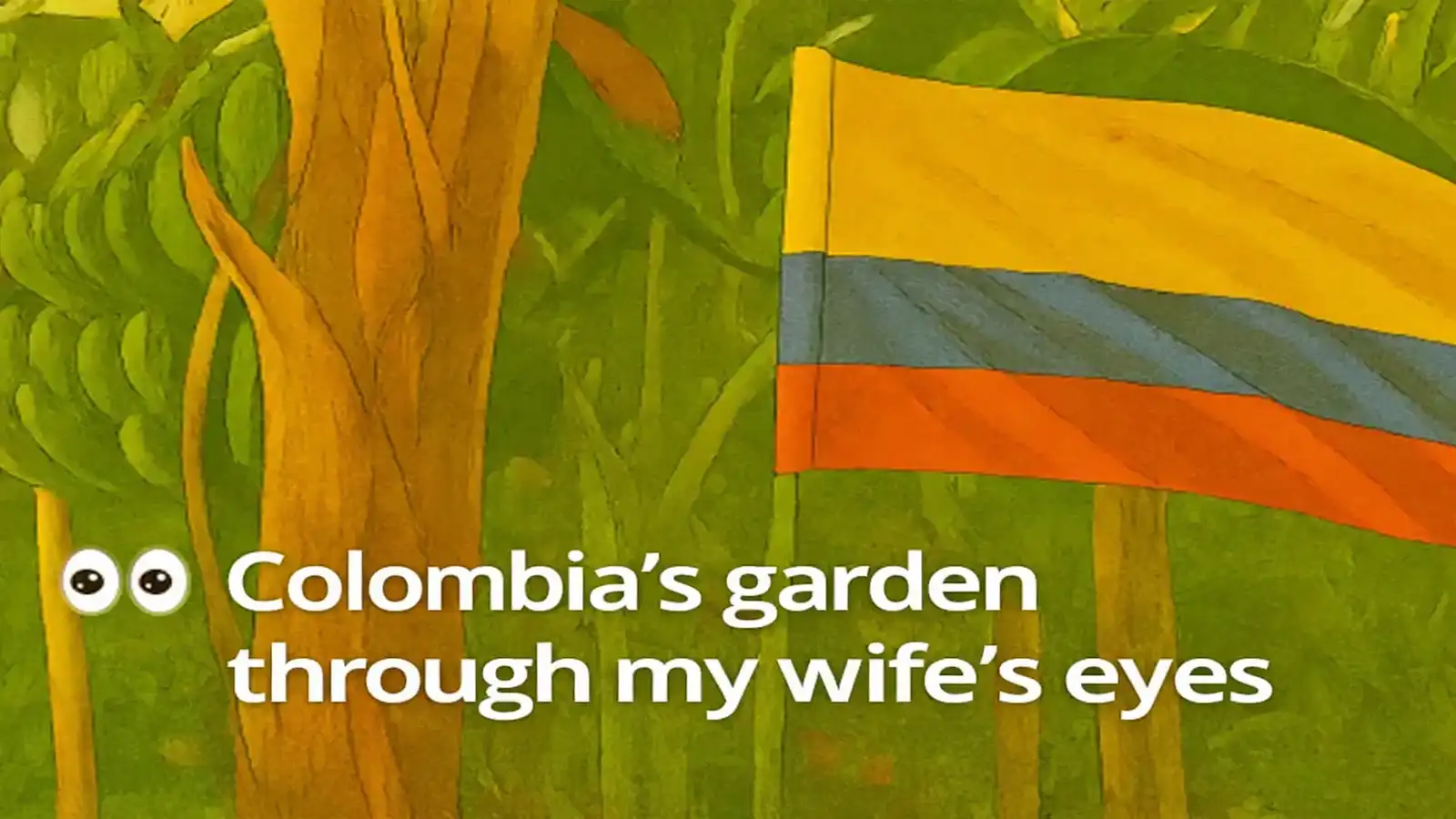
The Colombian farm garden from its roots, with love
When my wife visits Colombia, there is one place that transforms her: her mother’s farm garden. It’s not just any piece of land. It is a space sown with affections, living memories, unforgettable flavors. There, the earth speaks in a feminine voice, and every plant seems to tell a story that she listens to with devotion.
The Colombian farm garden, seen through her eyes, is much more than a crop. It is a universe of colors, aromas, and textures. It is a silent school where you learn to care, to wait, to be grateful. And it is also a bridge between her life in Murcia and her Cali roots. Colombia is a country of very diverse regions, each with its own way of speaking and understanding life. To learn more about those regional differences in Colombia, we invite you to discover the fun rivalries between “Costeños” and “Cachacos”, a classic of national humor.
Plantings that tell stories
In her mother’s farm garden, my wife rediscovers a symphony of fruits that awaken deep memories: banana and plantain trees offer shade and sweetness, while avocados hang like creamy promises harvested with gratitude. Passion fruit climbs boldly and perfumes the air with its vibrant acidity, and guava, with its pink pulp, paints childhood on the tongue. Lemons perfume the mornings, tree tomatoes ignite the landscape’s colors, and cherimoya, soft and sweet, brings smiles with every bite. Cassava, though not a fruit, is harvested with respect as an essential part of the cycle.
Corn rustles in the sun and evokes celebrations, while coffee, carefully grown, becomes a shared ritual. And among them all, the guama opens silently: with its long pods and its white, sweet, discreet pulp, it represents the unexpected—something grown not for profit but out of affection. Each fruit in this Colombian farm garden has a soul, and together they create an affective landscape where the earth speaks with a mother’s voice.
Knowledge and tradition in the Colombian farm garden
In her mother’s farm garden, my wife finds not only crops but also knowledge. Not the kind learned in classrooms, but the kind passed down in silence, between harvests and gatherings. It is wisdom that doesn’t fit in books but sustains life. There, planting follows the moon, pests are warded off with garlic and chili infusions, and the exact moment to harvest is recognized by smell, color, or touch. Guava leaves are used to heal wounds, cilantro water to soothe the stomach, and compost is made from peels, patience, and respect.
Her mother doesn’t speak of agroecology, but she practices it. She doesn’t use technical terms, but she knows the language of the land. And my wife, who grew up surrounded by screens and European schedules, sits down to listen. She learns with her eyes, her hands, her heart. And then, in Murcia, she adapts: improvising with pots, checking the weather, blending knowledge. Because the Colombian farm garden not only produces food: it produces memory, affection, and dignity.
The Colombian farm garden as resistance and community
In Colombia, many women support their families thanks to small farm gardens. They do more than feed: they educate, heal, protect. They are guardians of seeds, recipes, and stories. The Colombian farm garden is also a struggle: against scarcity, against the forgetting of ancestral knowledge, against dependence on industrialized products. My wife understands this and honors it. For her, every plant is an act of dignity. And every harvest, a silent victory. Just as the farm garden is an act of daily resistance, sharing a good Colombian coffee for two in Spain has become our daily ritual, a bridge that connects us with the land, with memory, and with the love we build far from our roots.
Seeds, migration, and memory
Although we don’t grow anything on our balcony, the land remains present in our lives. In my parents’ farm garden, my wife’s in-laws in Murcia, orange trees grow that perfume the air, lemon trees that give their bright acidity, olive trees that hold centuries of history, and fig trees that sweeten the summer. There, among plots and shade, she recognizes familiar gestures: the way of pruning, watering at dawn, picking fruit with respect.
And although the crops are not the same as in Colombia, something is repeated: the bond with the land, the silent wisdom, the shared care. Sometimes, when talking with other migrant women, memories arise of distant farm gardens, of seeds carried in pockets, of recipes that crossed the ocean. Thus, the Colombian farm garden not only adapts but intertwines with other lands, reinvents itself in every gesture, and flourishes where there is memory and willing hands to sow.
The Colombian farm garden as a school of life
In popular neighborhoods of Cali, in the rural areas of Valle del Cauca, in schoolyards and urban balconies, the Colombian farm garden multiplies as a space for meeting. Women, children, grandparents, and migrants sow together, share seeds, recipes, and advice. There are no hierarchies: the land levels everyone. My wife, by participating in these community farm gardens, discovers that knowledge is not kept but offered. What one learned in her Cali childhood, another adapts to her urban farm garden in Murcia. Thus, crops cross borders, and knowledge is woven as a living network between generations and cultures.
Lessons born from the land
The farm garden, for my wife, is more than cultivation: it is a silent teacher. It has taught her to wait without anxiety, to care without demanding, to accept life’s rhythms. Each planted seed reminds her that not everything sprouts, but everything teaches. In the Colombian farm garden, she has learned that time is not controlled, but accompanied; that the land is not dominated, but listened to. And she applies these lessons, born among plants and silences, to our relationship, to parenting, to cooking, to the way of being in the world.
Technology and the future of the Colombian farm garden
Today, even technology is put at the service of the farm garden. Applications like “Guide Your Farm Garden“, developed by Colombian universities, offer information on crops, traditional uses, and scientific recommendations. My wife, who used to sow by intuition, now consults apps, shares photos, and exchanges knowledge with other women on social media. The Colombian farm garden is becoming digital, but it doesn’t lose its soul.
Emotional harvest in the Colombian farm garden
The Colombian farm garden, seen through my wife’s eyes, is not just a place: it is a way of being in the world. It is living memory, a bridge between cultures, a seed of the future. And while she waters a plant in Murcia, I know that something of her land continues to beat within ours.
Video – The Colombian Farm Garden
In the last 40 seconds of this video, you can see the Colombian farm garden through my wife’s eyes. So getting to the end is worth it. Thank you for following us! We love you, followers!
🌿 What seed do you keep in your memory?
The farm garden is the mirror of the soul. We all have an aroma or a fruit that takes us back to our roots, no matter how far away we are.
The aroma of home:
Which plant or fruit instantly transports you back to your grandparents’ house or your childhood?
Inherited wisdom:
What piece of advice about the land did your mother or father give you that you still apply today (even if it’s just in a pot on the balcony)?
The land unites us all! Share that “green” memory you hold in your heart with us here in the comments below. 👇