
The Independence of Colombia was a complex historical process that marked the birth of the Colombian nation and the definitive break with Spanish colonial rule. More than isolated battles, it was a struggle of ideas, identity and courage that forever transformed the political, social and cultural reality of the region. In this article we explore the causes, the decisive moments and the protagonists of this feat that gave rise to the homeland history of Colombia and a new republic in Latin America.
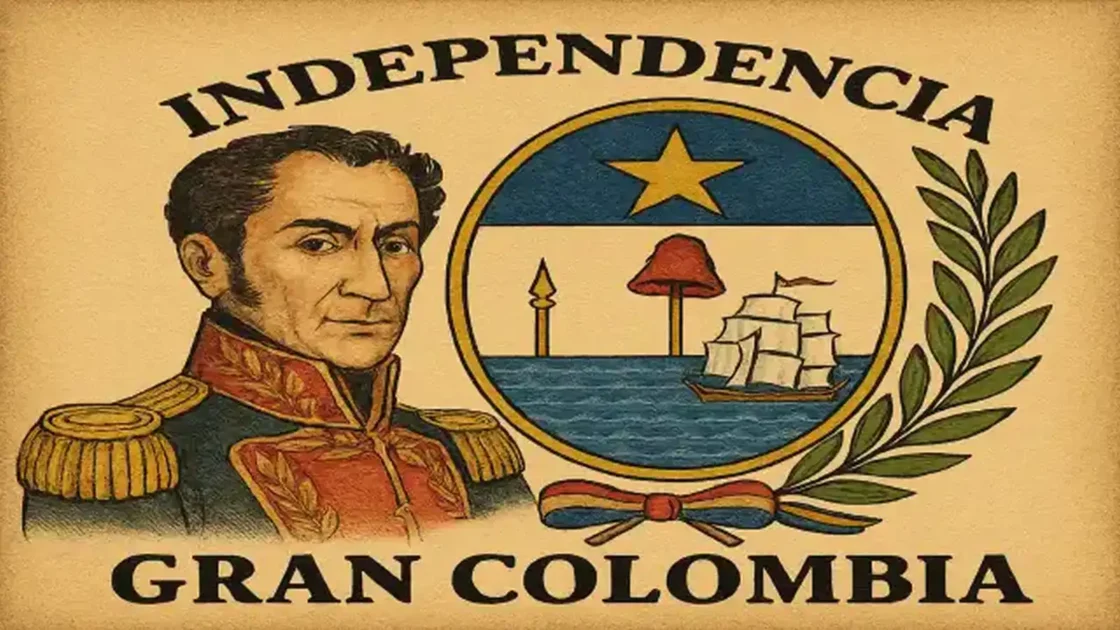
Independence of Colombia: Homeland history explained
The independence of Colombia was the moment when the Creoles ceased to be seen as subjects and began to imagine themselves as free citizens, capable of building their own destiny. The home story of Colombia is born here: in the courage of those who faced empires, in the ideals that crossed mountains, and in the symbols that still unite them as a country today.
And I say it as Spanish with the respect that deserves a story that is also part of ours. To know the independence of Colombia is not only to understand how colonial ties were broken, but how a self-identity was forged, courageous and determined.
Colombia was not only free from Spanish rule; it was freed from an imposed vision, and built its own with courage and conviction. This story challenges me as a European, as a Spanish speaker, and as someone who believes that freedom and dignity have no borders. It is a story that deserves to be told from both sides of the ocean.
The Viceroyalty of New Granada and its role before independence
Before Colombia existed as an independent nation, this territory was part of the New Granada Viceroyalty, an extensive colonial region under the rule of the Spanish Empire. As a Spanish, I find it fascinating to understand how this entity was much more than a simple administrative division: it was a complex political, economic and cultural network that encompassed what we now know as Colombia, Venezuela, Ecuador and Panama.
Officially created in 1717 by the Spanish Crown, the viceroyalty emerged in response to the need to exercise more direct control over the American territories, especially for their strategic value and natural resources. Its capital was Santa Fe de Bogotá, and from there there were governed vast areas with a hierarchical structure that favored the peninsulars – Spanish born in Europe –, while the Creoles, born in America, were relegated to the background, excluded from the important positions and decisions that affected their own land.
The Viceroyalty of New Granada was not only the scene of colonial administration, but also of rising tensions, Bourbon reforms, enlightened movements and rebellions such as that of the community members in 1781. It was a space where the first ideas of autonomy were conceived, where the seed of republicanism began to germinate, and where the neo-Granadine identity began to differentiate itself from the metropolis. Over time, this viceroyalty became the epicenter of the independence struggles that would give rise to Colombia and other sister republics.
From my perspective as Spanish, it is revealing to see how an imperial structure that sought to consolidate power ended up being the fertile ground for a thought revolution. The Viceroyalty of New Granada was, in many ways, the laboratory where imposition and resistance, tradition and change were mixed, giving way to a story that today is still alive in the memory of millions.
The Cry of Independence: What happened on July 20, 1810?
The famous Florero de Llorente was the symbolic trigger. A group of Creoles provoked a fight with the Spanish merchant José González Llorente to justify the creation of a government board. That day, Bogotá got up, and although formal independence was not declared, the process began.
The main causes of the independence of Colombia
Independence was not born out of nowhere. These were the main causes:
Social inequality: Creoles had no access to power.
Enlightened Ideas: Influence of the French Revolution and U.S. Independence
Crisis in Spain: The Napoleonic invasion weakened colonial control.
Desire for self-government: The Creoles wanted to decide on their land and their destiny.
The Fatherland Boba: internal division and consequences
Between 1810 and 1816, Colombia experienced a period of chaos known as La Patria Boba. The cities formed independent together and began fighting among themselves. Bogota and Tunja clashed, and instead of joining forces against Spain, they split. During the turbulent years of the so-called Patria Boba, Colombia sought not only its independence, but also its identity. What could be the birth of a solid republic became a labyrinth of ambitions and disagreements.
Political fragmentation was like a crack that opened between provinces that, instead of joining, were entrenched in their own visions of power. Each region believed itself to be the center of the universe, and local boards acted as small kingdoms in ego warfare.
The internal wars were not simple skirmishes: they were storms that faced brothers against brothers, patriots against patriots. The enemy ceased to be the Spanish empire at times, and became the neighbor with another flag and another model of government.
And while the country was bleeding into disputes, the patriot movement weakened like a flame exposed to the wind. The liberating cause, which should be the common beacon, became a fragmented idea, without a clear direction, vulnerable to the Spanish reconquest that soon took advantage of the chaos.
The Spanish Reconquest: the attempt to regain control
After the years of chaos and division that marked the Boba Homeland, Spanish dominance returned as a shadow that spread over the dreams of freedom. The Reconquista not only brought armies, but also fear, persecutions and executions that sought to put out the fire of independence. In the midst of that oppressive climate, a figure rose that defied terror with dignity: Policarpa Salavarrieta, known as La Pola. Spy, seamstress and patriot, she knitted more than fabrics: she weaved networks of resistance. His capture was a blow to the insurgents, but his death became a symbol.
On November 14, 1817, in front of the firing squad in the Plaza Mayor of Bogotá, there was no supplication or silence. With a firm voice and a defiant look, he shouted that still resounds in the story: “Die the tyranny!” It wasn’t just a phrase: it was an act of rebellion, a statement of principle, a fearless farewell.
That moment, more than an execution, was a testimony. Polycarp did not die: he became a legend. And in every corner where he fights against oppression, his voice is still alive.
The Liberator Campaign and the Crossing of the Andes
In 1819, when the winds of freedom were still barely whispers among mountains, Simón Bolívar undertook a journey that would challenge not only the Spanish empire, but nature itself. From the burning lands of Venezuela, his army—formed by struggling plains in battle and homeland dreamers—struck into the unknown.
The crossing of the Andes was not a march, it was an epic. The Pisba Wasteland, with its thick fog, its sharp cold and invisible paths, became the scene of an almost superhuman test. Soldiers with sandals and T-shirts faced freezing temperatures, icy rains and terrain that devoured horses and supplies. Each step was a renunciation of comfort, every night a fight against abandonment.
But Bolivar did not back down. With my gaze fixed on Tunja, I knew that the sacrifice was not in vain. Despite the casualties, hunger and tiredness, his army emerged from the moor as a transformed force: not only by suffering, but by the conviction that freedom was within reach.
When he arrived in Tunja, he found no rest, but preparation. The final confrontation was approaching, and with him, the possibility of breaking the chains that still tied the New Granada. Bolivar not only crossed mountains: he crossed the threshold between hope and history.
Battle of Boyacá (August 7, 1819): the decisive victory
On August 7, 1819, the Boyacá Bridge was not just a crossroads over the Teatinos River: it became the stage where the story changed course. There, between the dust of the roads and the rumble of the rifles, the patriotic forces achieved a victory that was not only written with strategy, but with conviction.
The battle was brief but decisive. Bolívar and his commanders knew that this point was more than geographical: it was symbolic. By defeating the realistic army, not only was a line of defense broken, the last breath of Spanish rule over New Granada broke.
From that day on, the bridge ceased to be a simple step between peoples and became an emblem of freedom. Patriotic victory not only ensured control of the territory, but ignited an irreversible flame: independence was no longer an idea, it was a reality underway.
Birth of Gran Colombia: vision and challenges
In 1821, under the burning sun of Cúcuta and the echo of libertarian ideals, a congress that would change the fate of America met. From there was born the Gran Colombia, a republic that united the territories of what we know today as Colombia, Venezuela, Ecuador and Panama. It was more than a nation: it was the dream of continental unity that Simon Bolivar carried in his soul.
Bolívar assumed the presidency with the vision of a strong and cohesive America, while Francisco de Paula Santander took the reins as vice president, bringing order and structure to the nascent State. However, what began as a shared hope was soon fractured by political tensions, regional interests and irreconcilable differences. In 1831, that dream faded, and Gran Colombia dissolved, leaving behind an indelible mark on Latin American history.
Key Characters of Colombia’s Independence
| Name | Historical contribution |
|---|---|
| Simón Bolívar | Military and political leader |
| Francisco de Paula Santander | Organizer of the Nascent Republic |
| Antonio Nariño | Human Rights Diffuser |
| Policarpa Salavarrieta | Spy patriot and martyr |
| Camilo Torres Tenorio | Author of the “Memorial of Grievances” |
| José María Barreiro | Spanish General defeated in Boyacá |
Important dates in the independence of Colombia
| Date | Key event |
|---|---|
| 20 July 1810 | Cry of Independence in Bogotá |
| 1816 | Spanish Reconquest |
| 7 August 1819 | Battle of Boyacá |
| 1821 | Congress of Cúcuta and creation of Gran Colombia |
| 1831 | Dissolution of Greater Colombia |
Current celebrations of the Independence of Colombia
July 20: Independence Day. Parades, civic acts, concerts.
August 7: Battle of Boyaca Day. Presidential possession and tributes.
Historical Curiosities of Colombia’s Independence
The vase of Llorente: It is in the Museum of Independence in Bogotá.
Policarpa Salavarrieta: It appears in bills and monuments.
Bolívar’s Dream: He dreamed of a united America, but local interests prevented him.
La Gran Colombia: It was one of the first attempts at Latin American integration.
Importance of knowing the independence of Colombia
Because understanding our past helps us value the present and build the future. Colombia’s independence is more than a story of battles: it is the story of a people who decided to be free, despite the obstacles. And although I do not belong to that land, knowing their struggle I have deep respect for those who faced empires with courage. Its history transcends borders and reminds us that freedom is a universal right that is conquered with conviction.
Conclusion: legacy of Independence and its validity
The independence of Colombia was a long process, complex and full of passion. He left us heroes, teachings and an identity that continues to evolve. Today, more than two centuries later, we continue to write our history in the same spirit of freedom. And although I am not Colombian, knowing this story it is impossible for me not to admire the strength of a people who rose up against the domain, who dreamed of a free homeland and who turned that dream into reality.
Colombia’s home story not only belongs to those who were born there, but inspires all those who believe in self-determination, justice and the power of ideas. It is a testimony that freedom is not inherited: it is conquered, defended and honored every day. Colombia did not only become independent; it taught the world that dignity has no borders. Long live the independence of Colombia!
Video summary of the Independence of Colombia and other data of interest
For more information about the home story of the Independence of Colombia in the future we may publish some article related to it. In the meantime you can take a look at the great knowledge of Wikipedia. On the other hand, as always we have more interesting articles in our Colombian Hispanic Blog
Discover the Independence of Colombia through books and historical products
If you are really interested in understanding the independence of Colombia from a critical and revealing look, there are two works that you can not miss:
“The independence of Colombia: forgetfulness and fictions” by Alfonso Múnera that is available in Kindle version, this book dismantles myths and rescues the forgotten role of Cartagena in the liberating feat. Múnera writes with depth and courage, inviting the reader to question what he thought he knew about the birth of the nation.
“The independence of Colombia: Así fue” by Irene Vasco Narrado by Juliana Peláez and published by Penguin Random House, this audiobook in Audible is ideal for the whole family. In just 1 hour and 35 minutes, it takes you through the key moments of independence with a warm and educational narrative.
Both titles are perfect for those who want to rediscover the homeland history from a more humane, critical and close perspective. Do you dare to read—or listen—to independence like never before?